Introduction
The four quarto volumes and supplement of Émile Littré's Dictionnaire de la langue française, published between 1862 and 1877, come to over 11 million words in total. That's longer than all the hundred novels of the ELTeC-Fra corpus combined.
Thankfully we have digital versions. François Gannaz's XMLittré project provides both a plain-text and an XML digitization of the full dictionary. In the XML edition, the internal structure of entries is represented by roughly 87,000 sub-entry blocks encoded as "<indent>" elements.
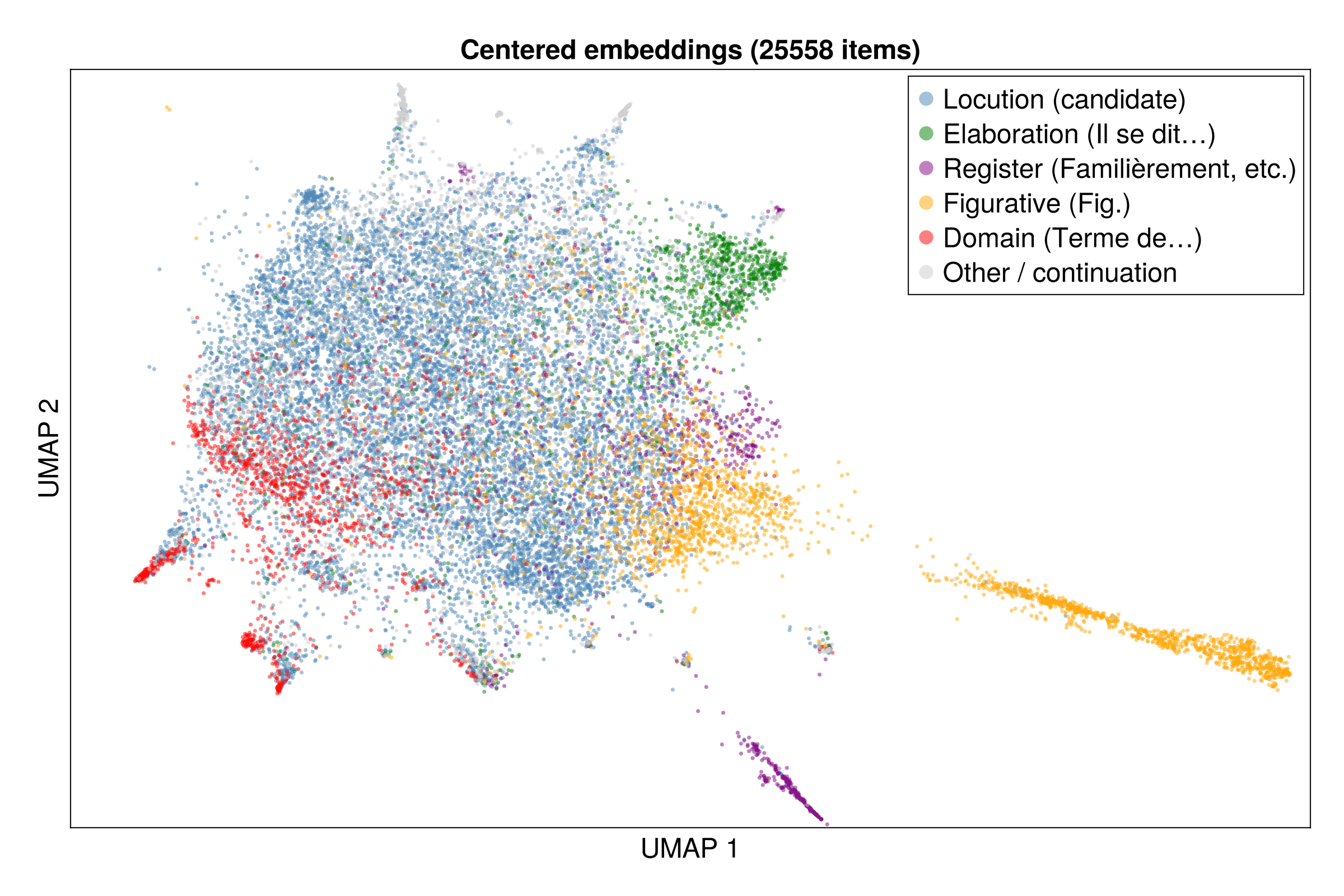
But the variety and structure of Littré's actual text are not fully captured by this flat, undifferentiated indent structure. Specifially, a typical entry in Littré contains a hierarchy of several kinds of information:
- Numbered senses — the core definitions, ordered from literal to abstract.
- Figurative extensions — senses marked Fig. or Figurément, where a word's meaning shifts metaphorically. Often nested under the literal sense they derive from.
- Domain labels — Terme de marine, Terme de musique, Terme de botanique — marking definitions specific to a technical field.
- Register labels — Familièrement, Populairement, Par extension — indicating the social or stylistic context of a usage.
- Locutions — fixed expressions defined under a headword (for example, "Tomber sous la main de quelqu'un" under headword main)
- Literary citations — dated quotations from authors spanning the 10th to the 19th century, serving as evidence for each sense.
- Etymologies and historical notes — tracing each word back through Old French, Provençal, and Latin with dated attestations.
While XMLittré preserves the text, it does not distinguish the different structural roles those elements play within an entry.
This is not a criticism of Gannaz’s work. Converting Littré into XML was a major undertaking—one that reportedly required hundreds or even thousands of hours. My own work, still in progress, has been a similarly meticulous task that builds directly on that effort.
My project introduced here, Deep-Littré, is an ongoing attempt to recover the internal structure of Littré’s entries and represent it explicitly. The goal is to make the dictionary easier to analyze computationally and more navigable for readers.
[Work in progress. To be continued.]